GETHSEMANE
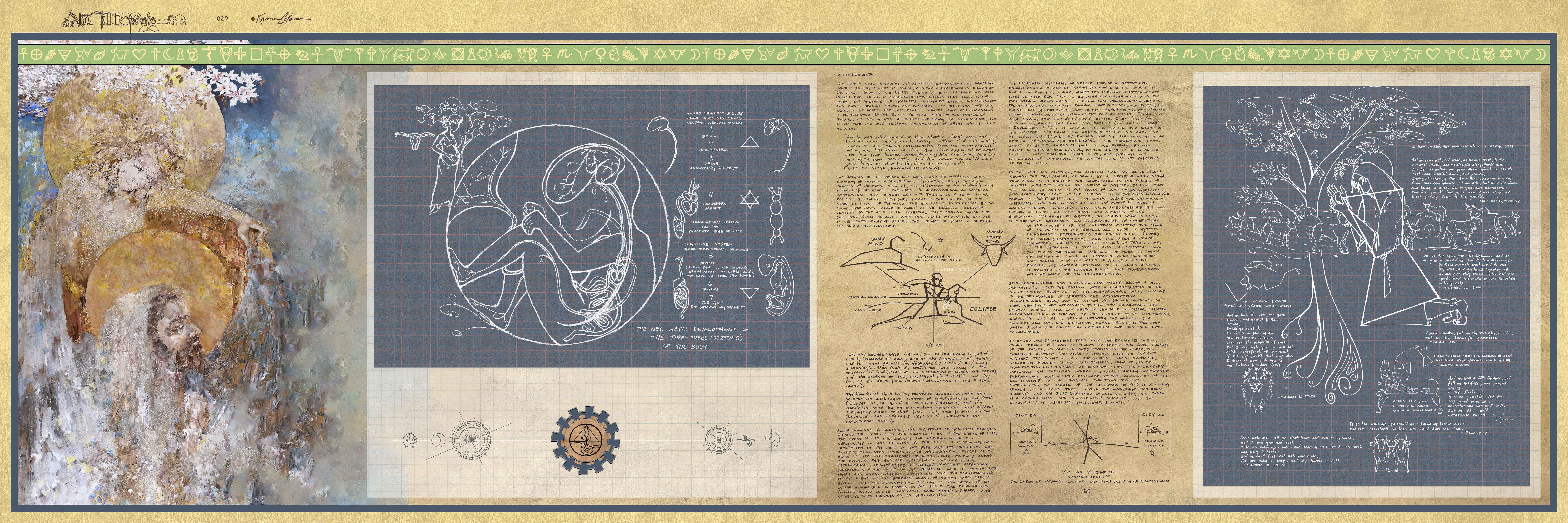
The Fourth Seal is Taurus, the midpoint between Leo and Aquarius. Taurus’ ruling planet is Venus, and the corresponding organ of the human body is the heart. Cycling in much the same way that oxygen-poor blood is exchanged for oxygen-rich blood in the heart, the Mysteries of Godliness recognize upbeats and downbeats and move through valves and chambers. In more than one way, Christ is the heart. For this reason, Christ’s love for humankind is represented by the blood He shed. Luke is the apostle of Taurus, or the witness of Christ’s suffering in Gethsemane, and so we find the most visceral description of Jesus’ agony in his account:
“And he was withdrawn from them about a stone’s cast, and kneeled down, and prayed, saying, Father, if thou be willing, remove this cup (Crater constellation) from me: nevertheless not my will, but thine, be done. And there appeared an angel unto him from heaven, strengthening him. And being in an agony he prayed more earnestly: and his sweat was as it were great drops of blood falling down to the ground”
(Luke 22:41-44, parentheses added).
The enigma of the tauroctony scene and the Mithraic axiom, harmony of tension in opposition, is encapsulated in the final phrases of Hebrews 4:12 as, “a discerner of the thoughts and intents of the heart.” The scene is astronomical as well as anatomical and merges Leo with Taurus in a total solar eclipse. To think with one’s heart is the eclipse of the heart in front of the mind. The eclipse is intersected by the Logos (the navel-mark of Orion) at the celestial equator crossed by the axis of the celestial poles around which even the pole stars revolve. Upon that cross within the eclipse is the center point of peace. The Prince of Peace is Mithras, the Mediator/Thalmus.
“Let thy bowels (Egypt/Moon/Sin-Taurus) also be full of charity towards all men, and to the household of faith, and let virtue garnish thy thoughts (Babylon/Sun/Leo) unceasingly; then shall thy confidence wax strong in the presence of God (Israel at the intersection of heaven and earth); and the doctrine of the priesthood shall distil upon thy soul as the dews from heaven (secretions of the pineal gland).
The Holy Ghost shall be thy constant companion, and thy scepter an unchanging scepter of righteousness and truth (scepter in the hand of Mithras/Orion); and thy dominion shall be an everlasting dominion, and without compulsory means it shall flow unto thee forever and ever” (Doctrine and Covenants 121:45-46, emphases and parentheses added).
From culture to culture, the Mysteries of Godliness revolved around the production and consumption of the bread of life. The bread of life has earthly and heavenly elements. It germinates in and returns to the soil. It is crowned with exaltation in the heat of the fire and its nutrients are transubstantiated invisibly. The agricultural cycles of the bread of life are transposed over the soul’s journey along the covenant path and are written in the immutable astronomical architecture of heaven. Covenant astronomy describes how the cycle of the bread of life is accomplished again and again through saving the seed and transforming it into bread, in one eternal round of human lives called eternal life. The metaphysical cycling of the bread of life in the human soul is rooted in the soil of this profane and glorious world where immortal gods mingle, suffer, and celebrate with humankind, as humankind.
The Eleusinian Mysteries of Greece provide a pretext for understanding a god that leaves the world of the spirit to dwell on earth as a man. Hades fed Persephone pomegranate seeds to keep her cycling between the underworld and the terrestrial world above, a cycle that produced the seasons. The Neoplatonist majority thought that the ideal would be to break free of this cycle. Rather than preaching the philosopher’s model, Christ actually assumes the role of Hades, “I am he that liveth, and was dead; and, behold, I am alive for evermore, Amen; and have the keys of hell and of death” (Revelation 1:18). As God of the afterlife, the Christ of the mystery commands his disciples to eat his body and drink his blood. By eating, the disciple will gain an eternal ascending and descending, like Persephone, from spirit to spirit-embodied soul in one eternal round. Christ redefined the cycling of the Bread of Life as the kind of life that the gods live, and through His sacrament of communion He invites all of His disciples to do the same.
In the Christian mystery, the disciple was invited to ascend through the ordinances, or seals, by a series of quickenings that began with baptism and culminated in the theosis of oneness with the Father. The Christian mystery taught that the essence of Christ is the spark of divinity in everyman, and even every slave. It was likewise with the disenfranchised women in Jesus’ orbit whose intrinsic value was culturally suppressed. The Gospel writers cast the Marys in roles of ancient mystery archetypes. Like their predecessors Isis and Hathor of Egypt, or Persephone and Demeter of the Eleusinian Mysteries of Greece, the Marys were divine. They too were goddesses and everywoman. If understood in the context of the Christian mystery, the roles of the Marys in the Gospels are those of mystery hierophants representing the Virgin Spirit (Kore), the Bride (Persephone), and the Queen of Heaven (Demeter). Embodied in the mother of Jesus, Mary is the astronomical Virgin and the celestial cow. She is also the tree of life split asunder on which the sacrificial lamb was fastened while her heart was pierced with the nails of His Crucifixion. Finally, the material essence of the Queen of Heaven is exalted as the earthen burial tomb transfigured into the womb of the Resurrection.
Jesus exemplified how a mortal man might become a god. His initiation and His Passion were a demonstration of the divine nature. Every act of this performance was analogous to the ordinances of creation and resurrection accomplished every day by women who become mothers. In them new souls are introduced to life and immortals are reborn. Where a man can develop himself in lesser creative endeavors, such a woman, by her endowment of life-giving capacity and as a bridge between the worlds, is a goddess already. Her queendom, planet Earth, is the ship where a new soul comes for experience and old souls come to remember.
Extended like Prometheus’ torch into the benighted world, Christ models the way to follow to receive the same fulness of the Father, no matter one’s station in the world. The Christian Mystery had more in common with the ancient mystery traditions of all of the world’s great cultures, including greater Israel and Samaria, than it did the monotheistic institutions of Judaism in the first century. Similarly, the Christian Church, a totalitarian Neoplatonist bureaucracy, was a later development that oscillated in its relationship to the original Christian Mystery. Nevertheless, the theosis of the children of God is a living branch on a living tree. Though the language has been obscured and the stars darkened by electric light, the earth is a resurrection and divinization machine, and the clockworks of ascension have never slowed.
 KAMRON COLEMAN ART