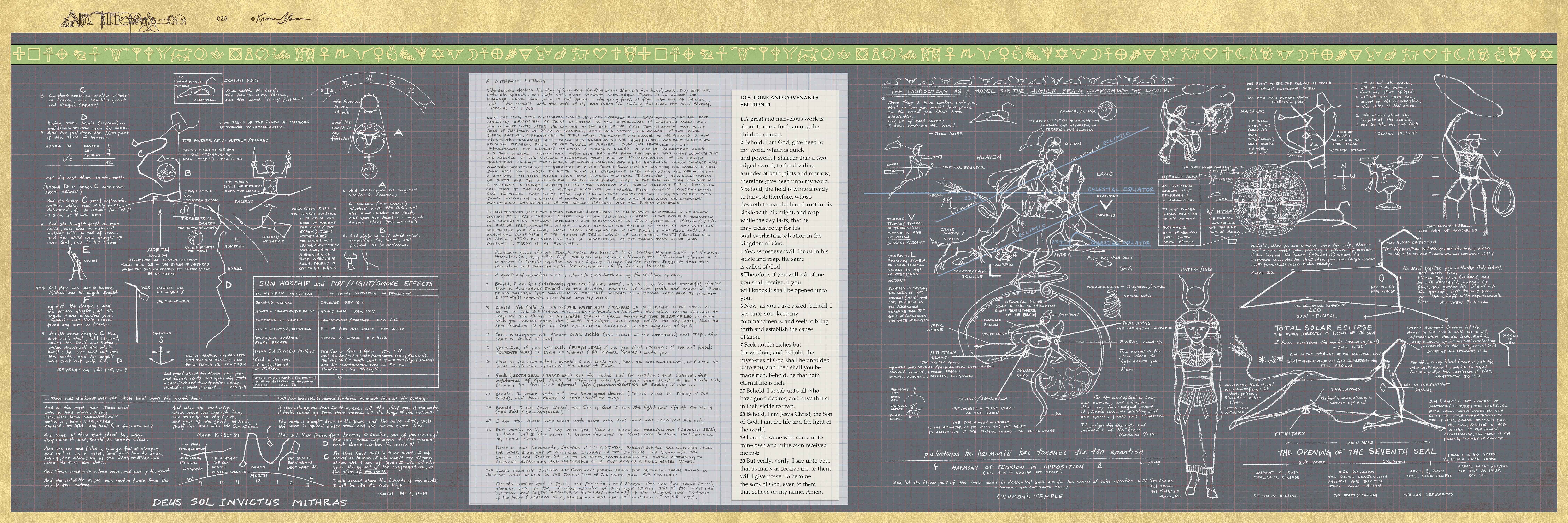
A MITHRAIC LITURGY
“The heavens declare the glory of God; and the firmament sheweth his handywork. Dayunto day uttereth speech, and night unto night sheweth knowledge. There is no speech nor language, where their voice is not heard… His going forth is from the end of heaven, and his circuit unto the ends of it: and there is nothing hid from the heat thereof” (Psalm 19: 1-3, 6).
What has long been considered John’s visionary experience in Revelation might be more correctly identified as John’s initiation in the mithraeum of Caesarea Maritima. This is most likely after his capture at the end of the first Jewish-Roman War. In the siege of Jerusalem in 70 AD at Passover, John and Simon, the leaders of two rival Jewish factions, surrendered to Titus after the temple was burned to the ground. Simon the Strong, acclaimed as a savior and guardian to the Jewish people, was cast to his death from the Tarpeian Rock at the Temple of Jupiter. John was sentenced to life imprisonment. The Caesarea Maritima mithraeum lacked a proper tauroctony scene and only a small tauroctonic medallion has ever been recovered. This might indicate that the absence of the typical tauroctony scene was an accommodation of the Jewish prohibition against the worship of graven images, even while handling pagan coinage was allowed. Additionally, in harmony with the Jewish tradition of writing the sacred history, John was commanded to write down his experience when ordinarily the reporting on a mystery initiation would have been severely punished. Revelation, as a substitution of sorts for the sculptural tauroctony scene, may be the only written account of a Mithraic liturgy dating to the first century and would account for it being the exception to the lack of written mystery accounts. It appears from internal contradictions and slanders that later redactors from other modes of Christianity embellished John’s initiation account in order to create a stark division between the emergent mainstream Christianity of the church fathers and the pagan mysteries.
Fifteen centuries after the Roman Church’s suppression of the Mystery of Mithras in the fourth century AD, Franz Cumont ignited public and scholarly interest in the possible association and comparisons between Mithraism and Christianity in The Mysteries of Mithra (1903). In May of 1829, however, a direct link between the Mystery of Mithras and Christian discipleship had already been taken for granted in the Doctrine and Covenants, a canonical scripture of the Church of Jesus Christ of Latter-day Saints (established in April 1830, by Joseph Smith). A description of the tauroctony scene and Mithraic liturgy is as follows:
Revelation given through Joseph Smith the Prophet to his brother Hyrum Smith, at Harmony, Pennsylvania, May 1829. This revelation was received through the Urim and Thummim in answer to Joseph’s supplication and inquiry. Joseph Smith’s history suggests that this revelation was received after the restoration of the Aaronic Priesthood.
1 A great and marvelous work is about to come forth among the children of men.
2 Behold, I am God (Mithras); give heed to my word, which is quick and powerful, sharper than a two-edged sword, to the dividing asunder of both joints and marrow (blade driven through the shoulder of the bull instead of a typical sacrifice by throat-slitting); therefore give heed unto my word.
3 Behold, the field is white (the white bull/Taurus of Mithraism is the field of wheat in the Eleusinian mysteries) already to harvest; therefore, whoso desireth to reap let him thrust in his sickle (Saturn hands Mithras the Sickle of Leo to take over the harvest from him) with his might, and reap while the day lasts, that he may treasure up for his soul everlasting salvation in the kingdom of God.
4 Yea, whosoever will thrust in his sickle (the Sickle of Leo asterism) and reap, the same is called of God.
5 Therefore, if you will ask (fifth seal) of me you shall receive; if you will knock (seventh seal) it shall be opened (the pineal gland) unto you.
6 Now, as you have asked, behold, I say unto you, keep my commandments, and seek to bring forth and establish the cause of Zion.
7 Seek (sixth seal- the third eye) not for riches but for wisdom; and, behold, the mysteries of God shall be unfolded unto you, and then shall you be made rich. Behold, he that hath eternal life (transmigration of souls) is rich… .
27 Behold, I speak unto all who have good desires (John’s wish to tarry in the flesh), and have thrust in their sickle to reap.
28 Behold, I am Jesus Christ, the Son of God. I am the life and the light of the world (the Sun/Sol Invictus).
29 I am the same who came unto mine own and mine own received me not;
30 But verily, verily, I say unto you, that as many as receive me (seventh seal), to them will I give power to become the sons of God, even to them that believe on my name. Amen.
Doctrine and Covenants, Section 11:1-7, 27-30 parentheticals and emphasis added. For other examples of Mithraic liturgy in the Doctrine and Covenants, see Section 12 and Section 88 in its entirety, particularly the verses pertaining to covenant astronomy and the parable of the man having a field, verses 41-63.
The verses from the Doctrine and Covenants borrow from the Mithraic theme found in Hebrews which relies on the tauroctony of the white bull for context:
For the word of God is quick, and powerful, and sharper than any two-edged sword, piercing even to the dividing asunder of soul and spirit, and of the joints and marrow, and is [the Mediator/Mithras/Thalmus] of the thoughts and intents of the heart (Hebrews 4:12, bracketed words replace “a discerner” in the KJV).
 KAMRON COLEMAN ART