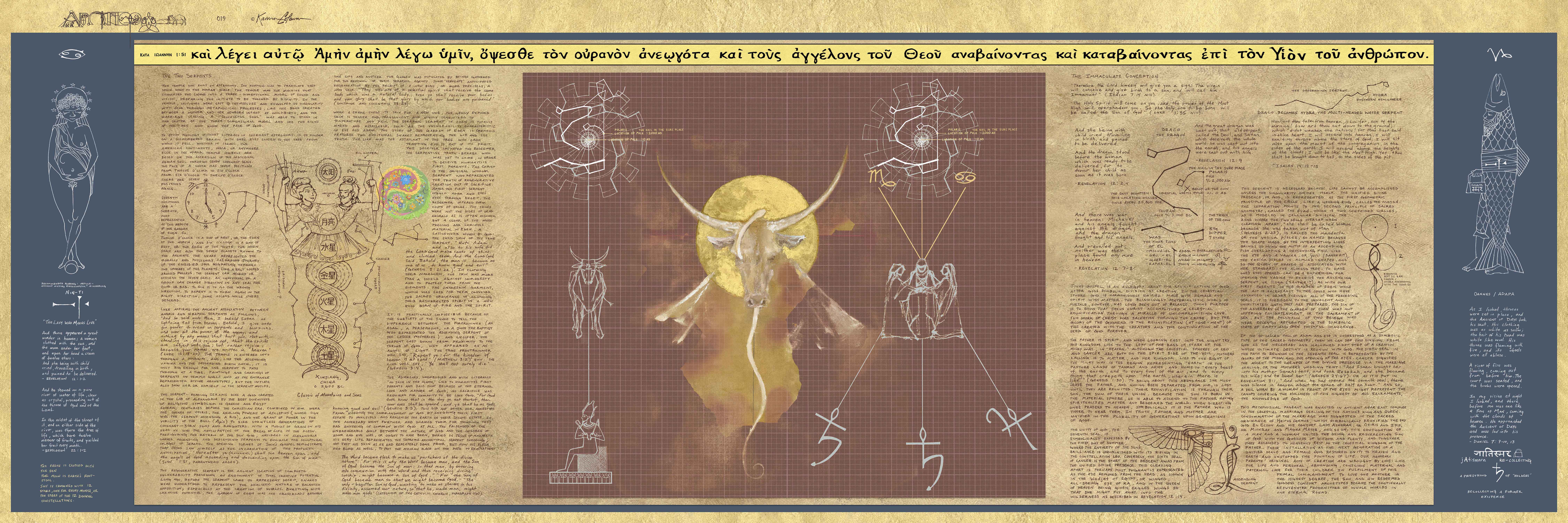
THE TWO SERPENTS
The temple was built on astronomy. Its purpose was to translate vast space down to the human scale. The temple was the machine that converted the cosmos into a three-dimensional model of sound and vision, preparing the initiate to be touched by divinity. In the temple, initiates were lost to themselves and engulfed in singularity with God through metaphysical processes, like the bond created between a mother and her newborn infant at childbirth, and the marriage sealing. A “successful soul” was able to stand in the center of the three-dimensional model and see the signs of the times and know the face of God.
To study theology without literacy in covenant astronomy is to ponder on a dismembered branch with one’s eyes closed to the tree from which it fell. Whether in Israel, the American continents, India, or anywhere else in the world, temple symbols are based on the ascension of the individual human soul through seven covenant seals. The face of a clock has seven positions from twelve o’clock to six o’clock. From six o’clock to twelve o’clock there are seven positions again. Seventh positions are a sabbath, also represented as the repose of the Garden of Eden. So, twelve o’clock is a day of rest, or the Eden of the north, and six o’clock is a day of rest, or the Eden of the south. The seven seals are also the seven planets known to the ancients. The snake represented the morally and physically hazardous journey of the embodied soul migrating through the spheres of the planets. Like a belt looped around pulleys, the serpent can ascend or descend the seven seals. An individual or a group can change direction on any seal for good or bad. To sin is to go the wrong direction. To repent is to turn again in the right direction. Some ascend while others descend.
Luke affirms the ancient association between angels and seraphic serpents as follows, “And he said unto them, I beheld Satan as lightning fall from heaven. Behold, I give unto you power to tread on serpents and scorpions, and over all the power of the enemy: and nothing by any means shall hurt you. Notwithstanding in this rejoice not, that the spirits are subject unto you; but rather rejoice, because your names are written in heaven” (Luke 10:18-20). The temple is entered into through a doorway, and, like the ascending vagina and the descending birth canal, it is only big enough for one serpent to pass through at a time. Paintings and carvings of serpents on temple walls and at the entrance represented divine archetypes, but the initiate also saw her or himself in the serpent motifs.
The serpent-bearing Serapis was a god created in the lab of Alexandria by the best scientists of religious symbolism in Greece and Egypt several centuries before the Christian era. Combined in him were the genes of Osiris, the healing powers of Asclepius (whose sign was the serpent ascending a rod), and the grant of power in the virility of the bull (Apis) to sire countless generations of covenant-born sons and daughters. With a modius of grain on his head he was the anticipation of the bread of life in the flesh. Prefiguring the return of the Sun God, artisans in Alexandria carved ascending and descending serpents to encircle the sculptural images of Serapis. The opening scenes of John’s Gospel demonstrate that Jesus saw himself as the incarnation of this prophetic anticipation, “Hereafter ye (Nathaniel) shall see heaven open, and the angels of God ascending and descending upon the Son of man” (John 1:51, parenthesis added).
The regenerative serpent is the ancient ideation of complete vulnerability preceding an endowment of total creative potential. Long ago, before the serpent came to represent deceit, snakes were understood to represent the dualistic nature of balanced opposition, especially at the creation of worlds. Bursting with creative potential, the Garden of Eden was the crossroads between one life and another. The Garden was populated by beings gathered for the renewal of their seraphic agency. These “serpents” anticipated regeneration by the receipt of a new body, or more precisely, a new skin. “They who are of a celestial spirit shall receive the same body which was a natural body; even ye shall receive your bodies and your glory shall be that glory by which your bodies are quickened” (Doctrine and Covenants 88:28).
When a snake sheds its skin for a new one, the newly exposed skin is tender and translucent and highly sensitized to temperature and pain. The seraphic serpent in Eden is totally naked and assailable, such as the vulnerability characteristic of Eve and Adam. The story of the Garden of Eden in Genesis features two additional snakes representing the lie and the truth. The liar was the assailant in the tree who came tempting Eve to eat of its fruit. This deceiver imitated the Redeemer, the serpentine truth-bearer who was yet to come, in order to deceive humanity’s first parents. The Christ is the original wisdom serpent who represented the truth of regenerative creation out of sacrifice. After the first serpent opened Adam and Eve’s eyes through deceit, the Redeemer offered them coats of skins. The skins were not the hides of dead animals as is often assumed, but a cloak of the most precious and luminous material in Eden, a latticework woven by God: the shed skin of the true serpent. “Unto Adam and also to his wife did the LORD God make coats of skins, and clothed them. And the LORD God said, Behold, the man is become as one of us, to know good and evil” (Genesis 3:21, 22). In clothing their nakedness, the skin was more than a shield against immodesty and to protect them from the elements. The snakeskin garment, which was shed for them, conveyed the sacred ordinance of clothing their resurrected spirit in a new body born of fire and the Spirit.
It is practically impossible because of the subtlety of the snake to tell the difference between the forerunner (an Adam, a Persephone, or a John the Baptist who represented the ascending serpent of the lesser mysteries) and Lucifer, the serpent cast down from proximity to the throne of God, who appeared as an angel of light. The true frontrunner will say, “Repent ye: for the kingdom of heaven is at hand” (Matthew 3:2) but the liar will say, “Ye shall not surely die” (Genesis 3:4).
The Adversary, unembodied and with literally “no skin in the game,” lied to humanity’s first parents and said that because of the eternal love and nature of God, no sacrifice was required for humanity to be like God. “For God doth know that in the day ye eat thereof, then your eyes shall be opened, and ye shall be as gods, knowing good and evil” (Genesis 3:5). This did not deter our ancestors from heeding the commandment of God by shedding their first estate to multiply and replenish the earth in their second estate. So, the Adversary went further and shamed them for thinking they had anything in common with God at all. The falsehood of the unbreachable gulf between the nature of God and the children of Adam and Eve was, or ought to have been, buried in Jesus of Nazareth. His very life represented the supreme archetypal serpent shedding, not just his skin as he had repeatedly done prior, but now his flesh and blood as well, to put the human race on the path to exaltation:
The Word became flesh to make us “partakers of the divine nature”: “For this is why the Word became man, and the Son of God became the Son of man: so that man, by entering into communion with the Word and thus receiving divine sonship, might become a son of God.” “For the Son of God became man so that we might become God.” “The only-begotten Son of God, wanting to make us sharers in his divinity, assumed our nature, so that he, made man, might make men gods” (Catechism of the Catholic Church, paragraph 460).
THE IMMACULATE CONCEPTION
“Therefore the Lord himself will give you a sign: The virgin will conceive and give birth to a son, and will call him Immanuel” (Isaiah 7:14 NIV).
“The Holy Spirit will come on you, and the power of the Most High will overshadow you. So the holy one to be born will be called the Son of God” (Luke 1:35 NIV).
John’s Gospel is an allegory about the reunification of God after God’s symbolic division at Creation. In the celestial sphere God is harmoniously unified: male with female and spirit with matter. The blindingly materialistic world of mortals, however, has long been out of balance. John’s purpose is to show that Jesus Christ accomplished a celestial reunification through a miracle of uncompromising love. The work of Christ was salvation through the cross, but the glory of the Godhead is the reunification (at-one-ment) of the created with the Creators and the continuation of the seed of God forever.
The Father is Spirit, and when looking east into the night sky, his kingdom lies to the left of the band of stars of the Milky Way, in “heaven.” Although the celestial spheres of Leo and Cancer are both on the spirit side of the veil, Mother’s calling is to Matter, and her kingdom lies to the right of the Milky Way in the region representing “earth” or the pasture lands of Taurus and Aries, and home to “every beast of the earth, and to every fowl of the air, and to every thing that creepeth upon the earth, wherein there is life” (Genesis 1:30). To bring about this abundance She must leave the Father, and having been separated from Him, is lost until they are reunited. Their reunification is through their Son, the sum of their union. Because the Son is born in the material sphere, he is able to ascend to the Father having spiritualized matter and redeemed the world. When directing one’s prayers to heaven, symbolically it is the Father who is there to hear them. In truth, Father and Mother are unified in the plurality of generations upon generations of gods.
The unity of God, the seventh seal, is symbolically expressed by the first day of summer, where the entirety of the sun’s brilliance is undiminished with its rising in the constellation Leo. Conversely, the sixth seal of Cancer is the start of the descent away from the Unified Divine Presence. This cleaving apart is perhaps most poignantly represented as the eye removed from the head, as shown in the Wadjet of Egypt, or winged, all-seeing eye of Ra, and in the Queen of Heaven being given eagle’s wings so that she might fly away into the wilderness as described in Revelation 12:14.
This descent is necessary because life cannot be accomplished unless the singularity divides itself. The Unified Divine Presence, or God, is represented as the first geometric principle of the circle, like a wedding ring, called the monad. The separation points to the second principle of sacred geometry, called the dyad, which is two conjoined circles, and is modeled in cellular division. The zone where the two cells overlap when cleaving apart, “she shall be called Woman because she was taken out of Man” (Genesis 2:23), is called the mandorla or the vesica pisces, so named because the shape made by the intersecting lines brings to mind the motif of an ascending fish overlapping a descending fish. Like the eye and a vagina, or yoni (Sanskrit), the vesica pisces is almond-shaped, and so the Queen of Heaven is associated with her standard: the almond tree. To have one’s eyes opened can be a euphemism for opening the vagina to receive the ascending serpent, or linga (Sanskrit), as with our first parents in the Garden of Eden. While the act is sacrosanct to the souls who have advanced in order through all of the preceding seals, it is forbidden to the innocent and uninitiated until they are prepared. The sin of the Adversary in the Garden of Eden was not offering enlightenment, or the sacrament of sex, but the pollution of two beings who were recently replanted in the symbolic state of empty and open youthful innocence.
If the so-called Fall of Adam and Eve is understood as a symbolic type of this sacred geometry, then we can see this division from God as the necessary and hallowed first step of a creation whose ultimate destiny is reunion with God. The sixth seal in the path to reunion in the seventh seal is represented by the glory of the Moon and the opening of the eyes. Cancer signifies the ascent to the oneness of the Divine Presence via the marriage sealing, or the Mother’s wedding tent: “And Isaac brought her into his mother Sarah’s tent, and took Rebekah, and she became his wife; and he loved her” (Genesis 24:67). Or as it is put in Revelation 8:1, “And when he had opened the seventh seal, there was silence in heaven about the space of half an hour.” And so, a veil worn by a woman in front of the eyes might represent the canopy covering the holiness of this highest of all sacraments, the knowledge of God. This metaphysical pageant was enacted in ancient near east temples in the celestial marriage sealing of the nation’s king and queen. Consummation of the marriage was suggested in the sacred ordinance of hieros gamos, which symbolically reunified the sky God El Elyon and his consort Lady Asherah, or Osiris and Isis, or Mithras and Magna Mater, and so on. This conjugation of a man and a woman united the dying and resurrecting Son of God with the Goddess of Wisdom and plenty, and together they ascended to heavenly rest in the celestial kingdom of the Father. Their installation as the next generation of a unified male and female God restored unity to heaven and earth and unstopped the fountain of life. Our Heavenly Parents’ original acts of creation are wrought by love: love for life and personal, abounding, conscious, maternal and paternal love for their children. In fulfilment of this primal commandment to love one another in the highest degree, the Son and his redeemed Goddess consort archetypes became the continually rejuvenated progenitors of whole worlds in one eternal round.
 KAMRON COLEMAN ART