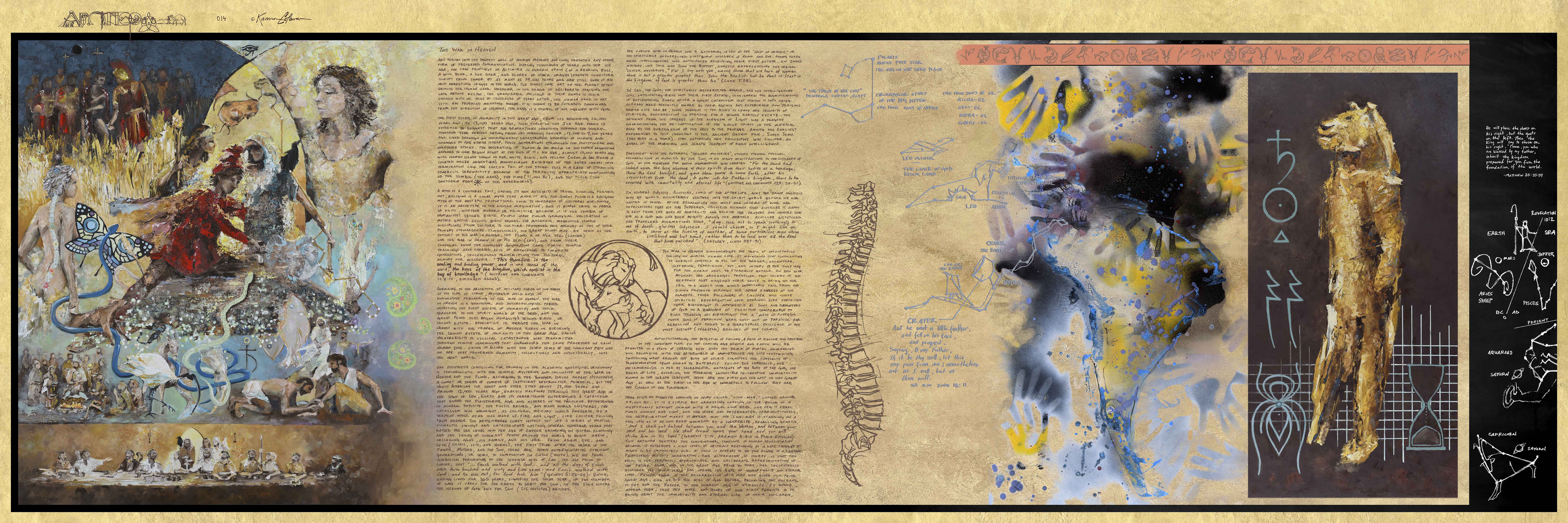
THE WAR IN HEAVEN
Art reaches into the deepest well of human memory and long predates any other form of preserved communication. Dating thousands of years into the Ice Age, the cave paintings of Altimira in modern Spain (of a rearing bull, a wild boar, a doe deer, and scores of other images) predate cuneiform script from Sumer by as many as 24,000 years and are still some of the most arresting images in the world. The oldest cave art on the planet often depicts the human hand. Wherever in the range of deliberate teaching the cave artists reside, the unavoidable message of their hands is their oneness with us. Tens of thousands of years later, the human hand in art still has profound meaning. Where it is shown to be extended downward from the direction of heaven, the hand is a symbol of our oneness with God.
The first estate of humanity in this Great Age, from its beginning 26,000 years ago, to 13,000 years ago, took place in the Ice Age. There is evidence to suggest that the generations surviving through the several thousand-year periods dating from Leo through Cancer, 13,000 to 9,000 years ago, lived through an unimaginably catastrophic upheaval of climate and changes to the earth itself. These generations straddled the Pleistocene and Holocene epochs. The decorating of Cueva de las Manos in southern Argentina appears to have begun right at the end of the Ice Age, almost 13,000 years ago, with human hands shown in red, white, black, and yellow. Cueva de las Manos is located where Argentina’s mountainous backbone of the Andes curves into termination like the coccyx tail of the spine. This is a case of stunning symbolic serendipity because of the perfectly appropriate compounding of the symbol (the hand), the time (11,000 BC), and the place (the southern Eden of the underworld).
A myth is a cultural fact, having its own authority of truth. Zooming further out, religion is a local myth that made it big. The Great Flood is a religious myth of the most epic proportions. Local to hundreds of cultures worldwide, it is an archetype in the human imagination, and it rings true to people of faith, whether modern or primitive because it is the symbol of humanity’s second birth. People have found geological validation of Mother Earth’s second birth travail for millennia. Meanwhile temple disciplines from culture to culture preserved this memory as one of their primary stewardships. Symbolically, the Great Flood may be seen as the consort to the War in Heaven. The Flood is in Her seal (Cancer) and the War in Heaven is in His (Leo), and from their conjugal union the covenant generation came forth. Temple teachings have carried keys of knowledge to countless generations, successfully transmitting this cultural memory for millennia. “This therefore is the sealing and binding power, and in one sense of the word, the keys of the kingdom, which consist in the key of knowledge” (Doctrine and Covenants 128:14, emphasis added).
Germaine to the archetype of military force on the earth at the time of Christ, Mithraism held keys of knowledge pertaining to the War in Heaven. The War in Heaven is a geological and anthropological period impacting the first estate of humanity and their transfer to the spirit world of the dead, and the great flood that began humanity’s second birth, or second estate. Revelation 12 merges the War in Heaven with the travail of Mother Earth in birthing the second estate of humanity in this Great Age. Earth’s vulnerability to cyclical catastrophe was transmitted through temple ceremonies that chronicled the same processes in each human soul. Living in accord with the seven seals of the covenant path was an ark that preserved humanity, collectively and individually, into the next world.
One hypothesis competing for primacy in the academic geological orthodoxy is synchronistic with the temple mysteries and inclusive of the War in Heaven and the Flood. According to the Younger Dryas Impact Hypothesis, a comet or series of comets of sufficient destructive potential, hit the North American ice sheet and other sites about 13,000 years ago. Around 13,000 years ago, exactly halfway through this Great Age in the sign of Leo, Earth and its inhabitants experienced a cataclysm that ended the Pleistocene age and ushered in the Holocene. Represented in mineral deposits, the fossil record, and many world cultures, the cataclysm was wrought, as cultural memory would preserve, by a serpent whose head was made of fire and light, like Lucifer falling from heaven. The remembered comet impact set off a series of volatile climactic swings and catastrophes lasting several thousand years that raised the sea level into the age of Cancer bringing on global flooding and the saving of covenant people around the world to begin anew, including Noah, his family, and his ark. From Adam, Eve, and Seth (Osiris, Isis, and Horus), the first triad after the order of the Father, Mother, and the Son, there are seven representative covenant generations, or seals, to completion in Enoch (Thoth). We see from symbolism pertaining to the seventh seal of Leo, the age prior to Cancer, that “…Enoch walked with God…and all the days of Enoch were three hundred and sixty and five years: and Enoch walked with God: and he was not; for God took him” (Genesis 5: 22-24). Enoch, having lived for 365 years, signifies the solar year, or the number of days it takes for the earth to orbit the sun, in the sign where the throne of God and the Sun (Sol Invictus) resides.
The fabled War in Heaven was a gathering in Leo of the “host of heaven,” or the spiritually resurrected firstborn children of Adam and Eve. Among these were intelligences who anticipated receiving their first estate. In John’s mystery, one such was John the Baptist, himself representing the vernal “lesser mysteries,” “For I say unto you, among those that are born of women there is not a greater prophet than John the Baptist: but he that is least in the kingdom of God is greater than he” (Luke 7:28).
In Leo, the Gods, the spiritually resurrected angels, and the intelligences still anticipating birth into their first estate, considered the ramifications of replenishing Earth after a great cataclysm that threw it into crisis. Already made perfectly aware by their agency and experience how perilous human life can be, some thought it too risky to leave the security of spiritual resurrection in paradise for a second earthly estate. The descent from the spheres of the kingdom of Light was a tragedy guaranteeing the re-captivation of the divine spirit in the material body by the subjugation of the holy to the profane. Among the earliest references to this ideology is the ancient Orphic pun, Soma Sema (the body is a tomb). One espousing this philosophy was Lucifer, an angel of the morning and seraph serpent of keen intelligence.
Consistent with the autumnal “greater mysteries,” others viewed physical resurrection, as modeled by the Son in his many ministrations to the children of God, as the measure for which humankind was created. “For the dead had looked upon the long absence of their spirits from their bodies as a bondage. These the Lord taught, and gave them power to come forth, after his resurrection from the dead, to enter into his Father’s kingdom, there to be crowned with immortality and eternal life” (Doctrine and Covenants 138:50-51).
In Homer’s Odyssey, Achilles, lord of the afterlife, asks the brave Odysseus why he would voluntarily venture into the spirit world before he had tasted of death. After recounting the woes and ordeals of war and deprivations that he has suffered, Odysseus assumes that Achilles is happy to rest from the woes of mortality and receive the prayers and honors due him as a god who had been mighty among the mortals. Achilles dispatched the traveler’s assumptions thus, “Nay, seek not to speak soothingly to me of death, glorious Odysseus. I should choose, so I might live on earth, to serve as the hireling of another, of some portionless man whose livelihood was but small, rather than to be lord over all the dead that have perished” (Odyssey, lines 487-91).
The War in Heaven acknowledges the peril of voluntarily taking on mortal human life. It maintains that covenanting to subject oneself to all of the danger, adventure, suffering, experience, joy, and injury is the only way for the human soul to eternally expand. In this war, Michael the archangel prevailed. Two-thirds of the heavenly host wagered their souls to bring up the tail in a world that would inevitably fall from the Divine Presence through the seven spheres of the planets. Those followers of Lucifer who chose spiritual resurrection over eternal life forfeited their birthright to apotheosis as Sons and Daughters of God in a bargain of perdition comparable to Esau trading his birthright for “a mess of pottage.” These sons of perdition were cast out of paradise for rebellion and bound to a terrestrial existence at the most distant (telestial) reaches of the cosmos.
Notwithstanding the potential of failure, a path of rescue was provided in the covenant plan. In the coming age heaven and earth will be reunited in a state of sabbath rest. Here the realm of mortal humankind will recombine with the afterworld of immortality. The life-sustaining swaddling wrap around the body of Osiris signifies the chrysalis of transformation from human to butterfly. Inside the chrysalis, the metamorphosis is fed by sacramental nutrients of the body of the god, the bread of life, assuring the otherwise impossible co-creative immortality known to the seraph serpents. These are the first and the last in this Great Age, as well as the first in the age of immortals to follow. They are the Church of the Firstborn.
There exists an exquisite carving in ivory called, “Lion-Man,” carved around 28,000 BC. It is a simple but arresting carving in-the-round of a majestically upright human with a regal lion head. One leg is equal parts human and lion, and the other has deteriorated. Serendipitously, the deterioration makes it appear that the Lion-Man is standing on a peg leg as if he had been wounded by a snakebite, recalling Genesis, “And I shall put hatred between you and the Woman, and between your seed and her seed. He shall tread upon your head and you will strike him in his heel” (Genesis 3:15 Aramaic Bible in Plain English). This artwork shatters the conventional timeline of human development because it evidences a high level of abstract reasoning at a date thought by many to be impossibly old. As such it appears to be the fluke of a random Paleolithic artist’s imagination. One alternative, of course, is that this relic is the perfectly appropriate and deliberate representation of an archetype of the Father Adam who, in the great age prior to ours, had successfully ascended the seven seals and opened the gate of immortality and eternal lives. Father Adam is the resurrection of a man who lived in a prior great age, and he did the will of God before becoming the husband to Eve and the Father to the current age of humanity. It would appear then, that the work and glory of our first parents is to bring about the immortality and eternal life of their children.
 KAMRON COLEMAN ART