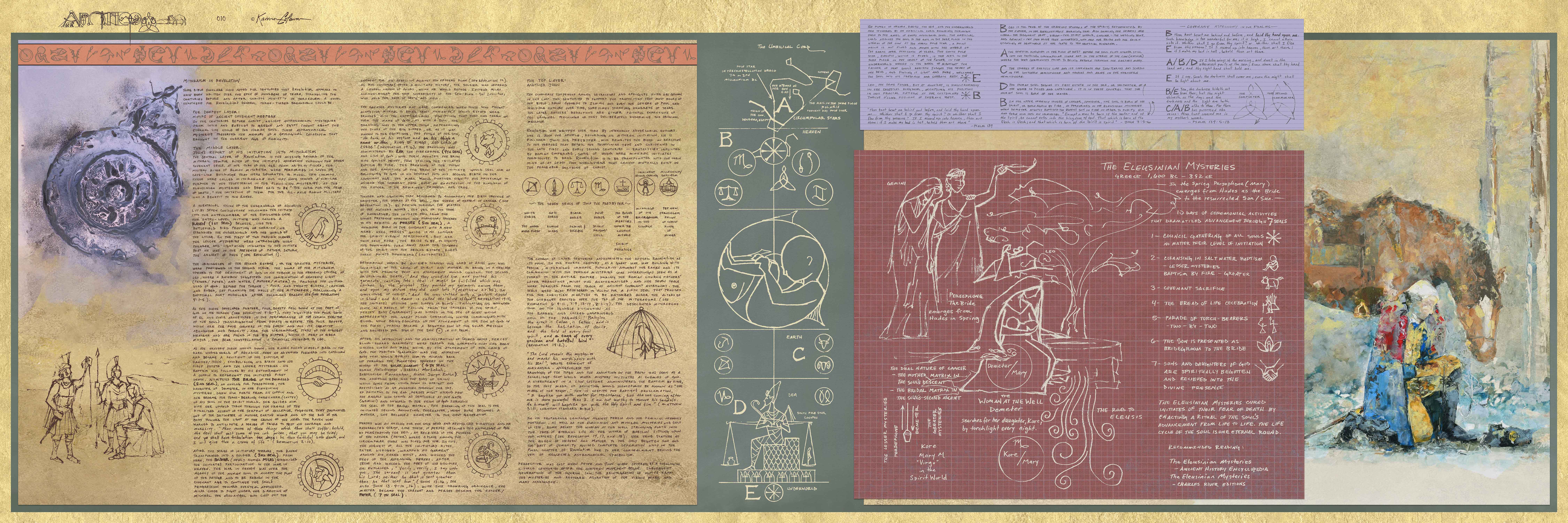
MITHRAISM IN REVELATION
Some Bible scholars have noted for centuries that Revelation appears to have been written over the span of hundreds of years, straddling the centuries before and after Christ’s ministry in Jerusalem. A novel hypothesis for Revelation’s general three-tiered breakdown could be:
THE DEEPEST LAYER:
MOTIFS OF ANCIENT COVENANT KEEPERS
In the centuries before Christ, ancient astronomical mysteries from India and Babylon to Greece and Egypt taught about the eternal life cycle of the human soul. These astronomical mysteries preserved the memory of a geological cataclysm that brought on the current age of humanity.
THE MIDDLE LAYER:
JOHN’S REPORT OF HIS INITIATION INTO MITHRAISM
The central layer of Revelation is the missing record of the Mithraic temple rites of the initiate’s ascension through the seven covenant seals. At the turn of the age from Aries to Pisces, the mystery rites of Roman Mithraism were performed in caves or cave-like buildings that were decorated to model the cosmos. These were called Mithraeums and may have served a similar purpose to the Telesterion in the Eleusinian Mysteries. As the Eleusinian Mysteries had been said to be “the cure for the fear of death,” the imitation of them for the all-male Roman military was a benefit to the ranks.
A theatrical vision of the underworld of Aquarius lit by seven candlesticks welcomed the initiate into the antechamber of the simulated cave. The entry-level initiate was called a Raven (1st seal) because, like the battlefield bird feasting on carrion, he straddled the underworld and the world of the living. In the first of two preview scenes, the lesser mysteries were introduced when thunder and lightning indicated to the initiate that he was in the presence of Father Saturn, the Ancient of Days (see Revelation 1).
The ordinances of the second estate, or the greater mysteries, were previewed in the second scene. The doors of the Mithraeum opened to the enactment of God on his throne in the heavenly sphere of Leo, where a rainbow suggested the combination of heavenly light (Father/Pater) and water (Mother/Mater) to produce the unified Dyad of God. Before the throne, “four and twenty elders,” crowned and robed, sat flanking the walls of the Mithraeum, overlooking a baptismal font modelled after Solomon’s Brazen Sea (see Revelation 4:1-5).
As this scene developed further, four beasts fell down at the feet of God on His throne (see Revelation 4:6-7). They signified the four Sons of El and their archetypes in the performance of the cosmic theatre of the soul’s transmigration from estate to estate. The four beasts, which are the four corners of the earth and all its creative abundance and ferocity, are the circumpolar stars of the highest heavens and are found in the Big Dipper, which is a part of Ursa Major, the Bear constellation, a celestial neighbor to Leo.
As the heavenly scene wound down, the Raven found himself back in the dark underworld of Aquarius. Then he advanced forward into Capricorn and became a recipient of the baptism of Oannes/John, symbolizing his birth into his first estate and the lesser mysteries. His baptism was followed by his entombment in a coffin to represent the initiate’s first death. Nymphus the Bride of the Deceased (2nd seal), an analog for Persephone, the daughter of Demeter in the Eleusinian Mysteries, drew him forth from his coffin and she became the torch-bearing caretaker (Cautes) of his soul in the spirit world. She guided him with her upheld torch through the ordeals of the ritualized ascent of the serpent of Asclepius. Together they journeyed out of the saltwater of Mother Earth’s womb and up the rod of the body toward the light at the crown of the head. The Raven was warned to anticipate a series of trials to test his courage and morality. “Fear none of those things which thou shalt suffer: behold, the devil shall cast some of you into prison, that you may be tried; and ye shall have tribulation ten days: be thou faithful unto death, and I will give thee a crown of life” (Revelation 2:10).
After this series of initiatory terrors, the Raven transformed into a soldier (3rd seal). From here, the soldier (newly named Miles) symbolized the initiate’s participation in the War in Heaven. The War in Heaven was over the agency of the human soul to accept the plan of the Father and to be reborn in the covenant age to continue the soul’s progression toward eventual apotheosis. Miles chose to fight under the direction of Michael the archangel who cast out the serpent for his rebellion against the Father’s plan (see Revelation 12). As was customary after a military victory, the soldier was offered a laurel crown of glory, which he would refuse. Instead, Miles acknowledged the sole sovereignty of the Sun King- Sol Invictus, who held the keys of death and hell.
The greater mysteries may have commenced when those who fought alongside Michael to bring about humanity’s second estate were branded with the Egyptian cross, signifying that they had taken on them the name of God. As with a bull, the branding was to the upper thigh, referencing the stars of the Big Dipper, or as it was known to the Egyptians, the Thigh of the Cow, “He hath on his vesture and on his thigh a name written, KING OF KINGS, AND LORD OF LORDS” (Revelation19:6). The branding was administered by Leo, the fire keeper (4th seal) and Lion of God, who then anointed the brow with golden honey, thus sealing the initiate’s baptism by fire. The branding of the thigh and the anointing of the brow of the initiate would seal him as belonging to God in his descent into his second birth in the covenant age. The mark would further signify his privilege to ascend the covenant path, even to exaltation in the kingdom of the Father if he remained faithful and true.
Thunder and lightning then returned to accompany the birth travails of Demeter, the woman at the well, the Queen of Heaven in Cancer (see Revelation 12). By passing through the matrix of the Mother’s womb, the veil of the tree of knowledge, the initiate fell from the Divine Presence through the planetary spheres to his rebirth as Perses (5th seal), a newborn born in the covenant with a new name. Here, Perses’ guide is no longer the spirit virgin Persephone, but her twin self, Kore, the bride-to-be. To signify the downward turn away from the spheres of the Spirit into the second estate, Kore’s torch points downward (Cautopates).
Redemption would be achieved through the Lamb of Aries who was sacrificed on the cross of spirit and matter to bring in a new age with the promise that his atonement would curtail the second, or spiritual death. “And they crucified him, and parted his garments, casting lots: that it might be fulfilled which was spoken by the prophet, They parted my garments among them, and upon my vesture they did cast lots” (Matthew 27:35). In similitude of Christ, “And he was clothed with a vesture dipped in blood: and his name is called the Word of God” (Revelation 19:13), the initiate’s vesture was dipped in blood. Indicating his wounded state as a result of falling from the spheres of the Spirit, Perses’ body (garment) was dipped in the sea of glass which represented the great flood containing water commingled with blood. Upon being educated on the atonement of the Sun of God in the flesh, Perses became a begotten son of the solar Messiah and received the sign of the Sun in his palm.
After his instruction and the administration of sacred oaths, Perses’ blood-soaked garments were traded for garments that had been washed clean and made white by the atonement of the Lamb of God. The purified garment was the ascension body that would qualify him to ascend back up through the planetary spheres on the wings of the solar chariot (6th seal: Roman Heliodromus, Israeli Merkabah, Babylonian Faravahar, Hindu Surya Ratha). The ascension body was the body of Orion which goes from lying down to upright and revitalized as he advances through the sky. If faithful to the end, Perses might ascend past the angels who stand as sentinels at the gate (Gemini) and onward to the vision of God through the seal of the bridal matrix. The breaking of this seal is the initiate’s second anointing. Thereafter, when Kore becomes a mother, she becomes the Demeter to the next generation.
Perses was an analog for the once dead and revitalized Dionysus and the resurrected Christ. Like these, if Perses obtained the knowledge of God by penetrating the veil, he received of the fulness of the Father (Pater) where a place among the circumpolar stars was fixed for him. In this, the highest of all the initiatory rites, Pater disrobed, wrapped his garment around his naked waist, and washed the feet of the ascending Perses. After Jesus had washed the feet of his disciples, he explained, “Verily, verily, I say unto you, The servant is not greater than his Lord; neither he that is sent greater than he that sent him” (John 13:16, see also John 13: 4-10,16). With this crowning ordinance, the master became the servant and Perses became the Father/Pater (7th seal).
THE TOP LAYER:
ANOTHER JOHN
The scholarly consensus among detractors and apologists alike has grown in the last two centuries to support the proposition that most books of the Bible, from Genesis to Isaiah and even the letters of Paul, had multiple authors over time, sometimes spanning hundreds of years. The later authors’ redactions are either faithful expansions of the original teachings or they deliberately undermine the original message.
Revelation was written over time by internally adversarial authors. One is John the Apostle, recording his Mithraic initiation. He is followed by John the Presbyter, who rewrites the book in reaction to the terrors that befell the Palestinian Jews and Christians in the late first and early second centuries- brutalities inflicted by Roman Emperors, some of whom were Mithraic initiates themselves. To read Revelation is to be transplanted into the torn mind of at least two worldviews that cannot mutually exist in the peaceable doctrine of Christ.
The church of later centuries appropriated the revised Revelation as its own. In the fourth century, as the menace of a great war was building with Persia, Mithraism’s immense popularity amongst the ranks and its communion with the Persian mysteries was increasingly seen as a threat to the entire empire. During the Roman Church fathers’ later redactions, Miles was anathematized, and the seven seals were derailed from the track of ancient covenant astronomy. The seals were also reordered to allow for a fifth seal that provides for the Christian martyrs to be entombed under the altars of the churches erected over the top of the Mithraeums (see Revelation 6:9-11, 7:9,13-17, 8:3-4). The desecrated Mithraeums took on the ignoble distinction as the barred and locked underworld hell of the pagans. “Babylon the great is fallen, is fallen, and is become the habitation of devils, and the hold of every foul spirit, and a cage of every unclean and hateful bird” (Revelation 18:2).
“The Lord reveals the mysteries and marks his worshippers with his seal”, wrote Clement of Alexandria. Nonetheless, the branding of the thigh and the anointing on the brow was seen as a sacrilege that would mark mystery initiates as enemies of God. A hierophant in a lion costume administered the baptism by fire, so the holy mark of anointing would thenceforth be known as “the mark of the beast.” This is despite the Baptist’s proclamation, “I baptize you with water for repentance, but the one who is coming after me is more powerful than I. I am not worthy to remove his sandals. He himself will baptize you with the Holy Spirit and fire” (Matthew 3:11, Christian Standard Bible).
In its propaganda campaign against Persia and the familial heavenly pantheon, as well as the Eleusinian and Mithraic Mysteries and Cult of Isis, Rome recast the woman at the well springing forth into the tree of eternal life as the Whore of Babylon sitting upon the waters (see Revelation 14, 17 and 18). Her true stature as the Queen of Heaven and Mother to the Only Begotten Son and the rest of humanity avoided complete defamation only in the final chapter of Revelation due to her concealment behind the veil of neglected astronomical symbolism.
Perspective was lost when Peter and John were severed by a theological divorce centuries after the Christian movement began. Subsequent generations of the Church saw the reintegration of motifs from the mysteries and restored adoration of the Virgin Mary and Mary Magdalene.
 KAMRON COLEMAN ART