OVERVIEW
THE ASCENSION VEHICLE:
AN AERIAL VIEW OF THE SCROLL
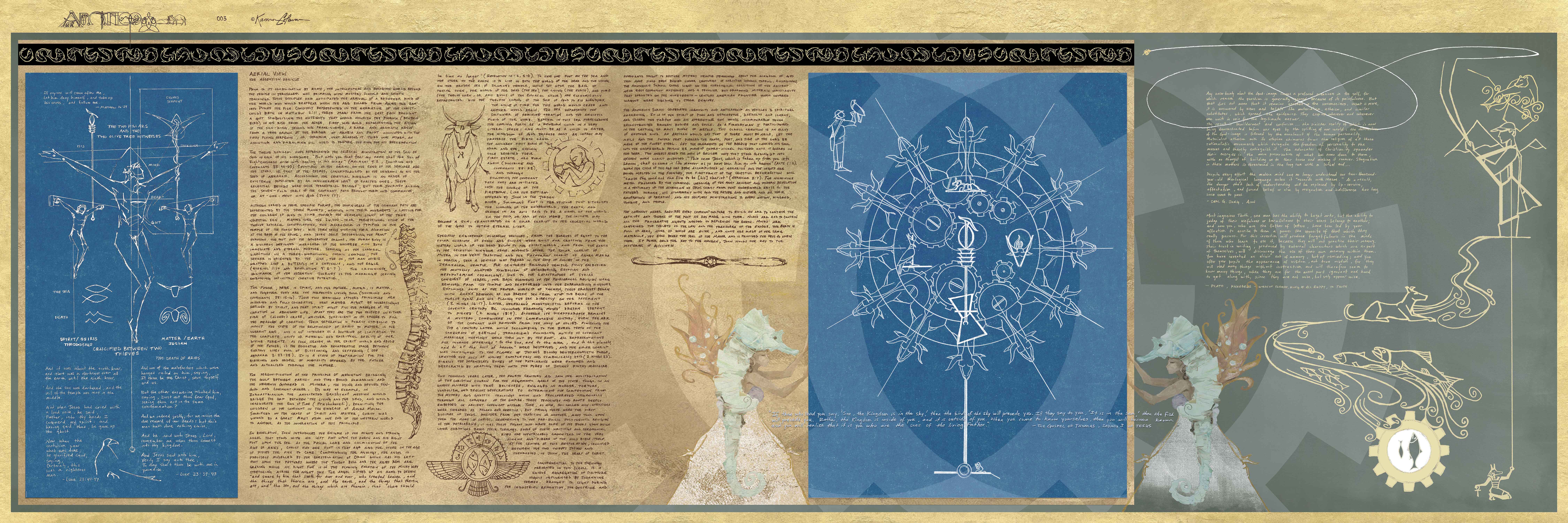
Prior to its consolidation by Rome, the intellectual and religious world beyond the temple in Jerusalem was brimming with mystery schools and gnostic teachings. These disciplines had anticipated the arrival of a redeemer king of the world who would reappear when the age rolled from Aries the ram into Pisces the fish. Concisely represented in the narrative of the Christ-child’s birth in Matthew 2:11, three magi from the east each brought a gift symbolizing the nutrients that would nourish the phoenix (Benben bird) in his rise from the ashes. First was gold, representing the rising of the sun-king. Second was frankincense, a rare and aromatic resin from a tree grown at the border of Arabia and Egypt associated with the fiery flying serpents, or seraphim, that guarded it. Third was myrrh, an anointing and embalming oil used to prepare the king for his resurrection.
The twelve zodiacal ages represented the celestial ministration of the Sun of God in each of his kingdoms. “But unto you that fear my name shall the Sun of righteousness arise with healing in his wings” (Malachi 4:2, Doctrine and Covenants 88: 45-63). Countless as the grains of sand on the seashore are the stars, or suns of the cosmos, conceptualized by the Hebrews as all the seed of Abraham. Accordingly, the Celestial Kingdom is an order of existence populated by an innumerable host of exalted ones. These celestial beings were once terrestrial beings, but their journey along the seven-fold seals of the covenant path brought them into communion, or at-one-ment, with God (John 17).
Although varied in their specific forms, the seven seals of the covenant path are represented by the seven planets, weaving with their movements a lattice for the children of God to climb toward the heavenly light of the true celestial sun. Mapped over the 26,000-year precessional cycle of the twelve zodiacal constellations, this macrocosm is typified in the temple of the human body. With seven seals starting their ascension at the base of the spine, and seven seals descending the front through the gut and the generative organs, the human body is a divinely designed microcosm of the universe with both immediate and eternal purpose. Serving as the cardinal directions on a three-dimensional cosmic compass, the seeker is oriented by the lion, the ox, the man Osiris wrapped like a butterfly in a chrysalis, and the eagle (Ezekiel 1:10 and Revelation 4:6-7). The crowning ordinance of the ascension journey is the marriage sealing embodying infinitely creative potential.
The Father, Pater, is Spirit, and the Mother, Mater, is Matter, and together they are the perfected living soul (Doctrine and Covenants 88:15-16). These two seemingly opposed principles are married and fully co-creative, that matter might be increasingly refined by spirit, and that spirit might fill the measure of its creation in abundant life. Apart they are the two thieves on either side of Calvary’s cross, neither sufficient in its sphere to fill the measure of creation. Their separation is purely symbolic to indict the state of the relationship of spirit to matter in the current age and is not intended as a doctrine of limitation to the complete unity or material and spiritual reality of our divine parents. As such, Heaven, or the spirit world and abode of the Father, is the educative and recuperative space between earthly lives full of blossoming and suffering (see Abraham 3:23-28). It is a state of preparation for the blessing and ordeal of mortality offered by the Father and actualized through the Mother.
The personification of the principle of mediation bridging the gulf between earth- and time-bound humankind and the heavenly Godhead is Mithra, the dying and revived Sun God and Covenant-Maker. By way of example, in Zoroastrianism the anticipated Saoshyant messiah would bridge the gap between the living and the dead, and would inaugurate the End of Time (Frashokereti), reuniting the children of the covenant in the embrace of Ahura Mazda. Sacrificed on the cross of spirit and matter, Christ was viewed by a great many from one end of the western world to another as the incarnation of this principle.
In Revelation, John introduces the enigma of the mighty and strong angel that stood with his left foot upon the earth and his right foot upon the sea. As the pascal lamb and culmination of the age of Aries, Christ had one foot in that age and the other in the age of Pisces the fish to come. Compounding the analogy, the angel is precisely modelled by the constellation of Orion which has his left foot upon the pastures where the Taurus bull and the Aries ram are grazing while his right foot is in the flowing fountain of the Milky Way stretching across the night sky. The angel lifted up his hand to heaven “and sware by him that liveth for ever and ever, who created heaven, and the things that therein are, and the earth, and the things that therein are, and the sea, and the things which are therein, that there should be time no longer” (Revelation 10:2, 5-6). To have one foot on the sea and the other on the earth is to live in both the world of the dead and the living. In the Brazen Sea of Solomon’s Temple, which sat upon the back of twelve oxen, the world of the dead (the sea), the living (the earth), and time (the twelve oxen, or Apis Bulls of the zodiacal cycle) are economically represented. With the twelfth coming of the Sun of God to his kingdoms, the cycle of time for this world would cease and another would begin. The sea represents the salt water of feminine creation and the amniotic fluid of the womb. Baptism in this sea foreshadows the coming forth as a newborn child in a very literal sense: one must be as a child to enter the kingdom of God because only an infant may traverse the birth canal. The children first born of Adam and Eve, having once received their first estate, are born again (Doctrine and Covenants 88:28), and through following the covenant path they are initiated into the church of the Firstborn. Like the baptism offered by John in the Jordan River, Solomon’s font is the vehicle that ritualizes the linking of the underworld, the earth, and heaven in an axis said to be a navel of the world. In the ship, or ark of this womb, the initiate may become a sun, transported on a solar chariot to the celestial world of the Gods to obtain eternal lives.
Specially engineered ascension vehicles, from the barques of Egypt to the solar chariots of Enoch and Elijah were built for crossing from the watery world of the dead below and to the spirit world, and from the earth to the celestial kingdom above. Modeled after the solar chariot of Mitra in the Vedic tradition and the Faravahar chariot of Ahura Mazda in Persia, such a vehicle was parked in the Holy of Holies in the Jerusalem temple. For centuries Solomon’s temple fully embodied the mutually adapted symbolism of neighboring Egyptian and Mesopotamian cosmology. Due to the catastrophes of Syria’s conquest of Israel, the basic elements of the patriarchal religion were removed from the temple and reabsorbed into the surrounding kingdoms. Explained away as the proper worship of Yahweh, these erasures began with Ahaz’s removal of the brazen sea from atop the backs of the twelve oxen and his placing the sea directly on the pavement (2 Kings 16:17). Later, Hezekiah’s monotheistic reforms in the seventh century BC included breaking Moses’ brazen serpent to pieces (2 Kings 18:4). Although its disappearance remains a mystery, somewhere in this lamentable history, even the Ark of the Covenant was removed from the Holy of Holies. Finishing the job a century later while succumbing to the bared teeth of the conquests of Babylon, Jerusalem’s founding motifs of covenant marriage theology were torn out by the root. All representations for incense offerings “to the sun, and to the moon, and to the planets, and to all the host of heaven” were destroyed, and the solar chariot was consigned to the flames of Josiah’s bloody Deuteronomist purge, leaving the Holy of Holies completely and symbolically void (2 Kings 23). Finally, the defenseless bones of the patriarchs were exhumed and desecrated by heaping them onto the pyres of Josiah’s filthy massacre.
One thousand years later, the fourth century AD saw the militarization of the Christian church for the hegemonic goals of the state. Thugs, in an unholy alliance with true believers, engaged in murder, torture, vandalism, and zealous desecrations to exterminate the competition from the mystery and gnostic teachings which had proliferated organically through all corners of the empire. These teachings had roots deeply embedded in ancient covenant wisdom. Then, as now, so-called non-Christians were smeared as pagans and heretics, but among these were the first disciples of Jesus. Whether from one tradition or another, many took upon them the name of Christ. Hearkening to the pre-exilic polytheistic religion of the patriarchs, it was these pagans who wrote some of the books upon which later Christians based their theology. Some of these writings and ceremonial rites are inextricably canonized in the very sinews and fibers of the Holy Bible itself. At the center of this restoration, crucified between the two thieves Josiah and Theodosius, is John, the heart of Christ.
Consequential to the theology presented in this Scroll is a unique aggregation of scripture highly influenced by Johannine themes. Brought to light during the Industrial Revolution, The Doctrine and Covenants sought to restore mystery temple teachings about the Kingdom of God that have since been buried under centuries of Christian church topsoil. Accordingly, The Apotheosis Scroll sheds light on the theological collision of the Ancient Near East covenant mysteries and a peculiar but profound Mithraic Christianity that sprouted on the nineteenth-century American frontier when covered wagons were yielding to steam engines.
The Apotheosis Scroll celebrates ingenuity and artisanship as vehicles to spiritual awakening. It is in the spirit of Ptah and Hephaestus, Daedalus and Icarus, and Joseph the Tekton and his apprentice Son whose incomparable touch reconstructed broken bodies and souls. As a foundryman I participated in the casting of many kinds of metals. This Scroll creation is an alloy of another kind. An artisan would say that if there must be nails, let the nails and the sword that pierced the hands, feet, and side of the Lord be made of the finest steel. Let the ornaments on the barque that carried his soul into the underworld prison be made of cupro-nickel polished until it gleams in the dark. Two angels asked the men of Galilee why they stood gazing up into heaven when Christ ascended. “This same Jesus, which is taken up from you into heaven, shall so come in like manner as ye have seen him go into heaven” (Acts 1:11). When the cycle of this age has been accomplished in Aquarius and the ingots are being melted in the foundry, the Firstfruit of the celestial resurrection will “cause the wind and the fire to be [his] chariot” (Abraham 2:7). The numinous metal produced by the chemical wedding of the most ancient and modern revelation is a testimony of the ascension of Jesus Christ from that underworld abyss to the Father’s throne, his atonement with God the Father and Mother and all their generations of creation, and his selfless ministrations to every nation, kindred, tongue, and people.
The Covenant Maker requires every covenant culture to build an ark to contain the articles and tokens of the pact He has made with them. Noah’s ark had to contain all the procreative agents needed to replenish the earth. Moses’ ark contained the tablets of the Law and the treasures of the Exodus. The earth is full of arks, none of which are alike, and none are made of the same materials, yet each bears the seal of the Maker and is provided the keys to open them. If Peter held the key to the church, John holds the key to the mysteries of Godliness.
 KAMRON COLEMAN ART